Marketplaces must deliver a unified and seamless experience across all customer touchpoints, from websites and apps to social media and offline interactions. This article explores why omnichannel consistency is now essential for success.
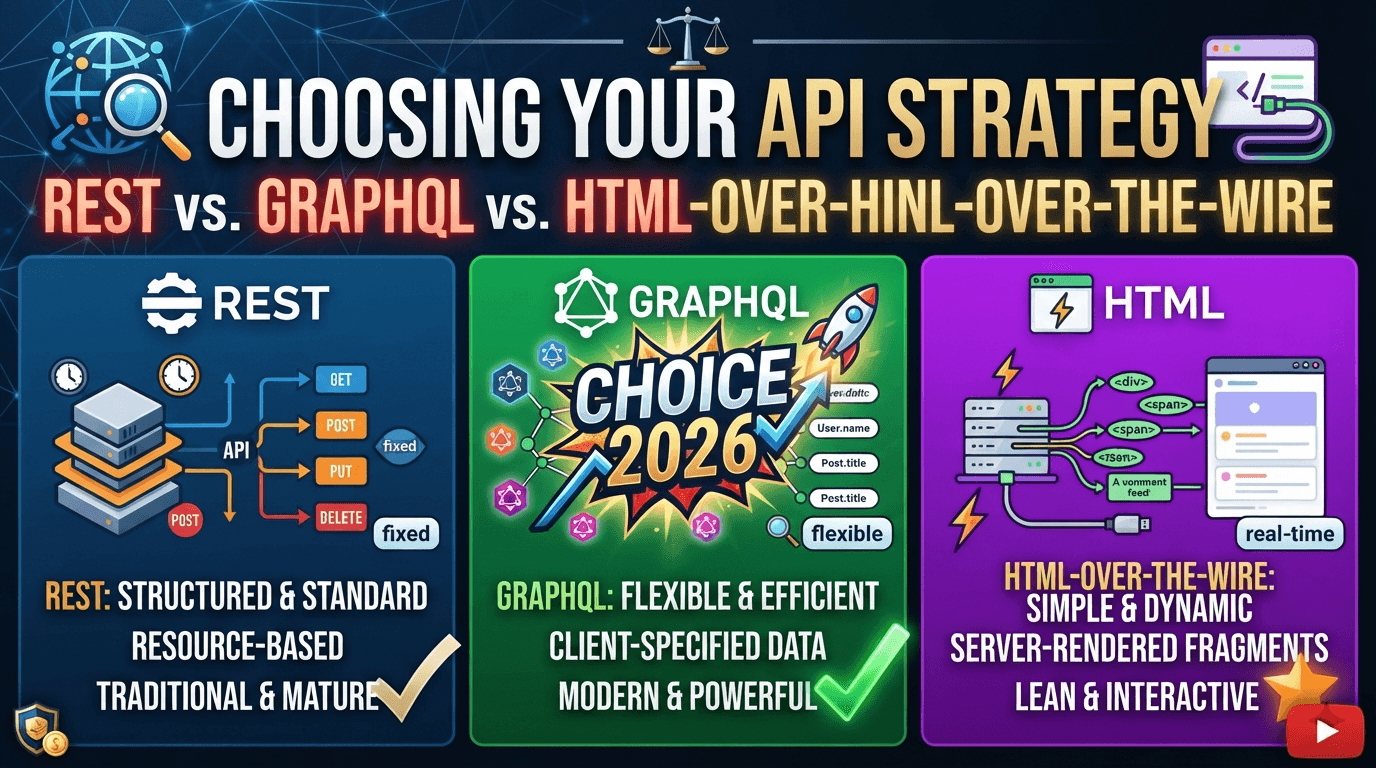
Explore the strengths and weaknesses of REST, GraphQL, and HTML-Over-the-Wire to select the optimal API strategy for your web application in today's evolving development landscape.
Discover how edge-first infrastructure revolutionizes web application performance by minimizing latency, enhancing user experience, and driving business success in a globally connected world. Learn why prioritizing proximity to users is crucial for modern web development.
Discover how a portfolio career blends freelancing, consulting, and personal projects into a diversified income stream, offering greater autonomy and financial resilience than traditional employment.
Explore how voice search and AI chatbots are transforming web user experience. Learn essential UX principles and technical considerations for developing conversational interfaces that thrive in a post-search world.
Serverless functions offer agility but introduce new security challenges. Learn how to identify and mitigate common vulnerabilities to protect your applications from an expanded attack surface.
Discover how integrating platform engineering with composable system design and FinOps principles can lead to highly scalable, cost-efficient, and future-proof software architectures.
Explore what AI-native development platforms truly offer, from boosting productivity to transforming innovation. Learn if these advanced tools are ready for your team's adoption now and what factors to consider for implementation.
Agentic AI is revolutionizing software development by automating complex, multi-step tasks. Discover how these intelligent tools enhance efficiency while emphasizing the indispensable role of human oversight in ensuring quality and ethical outcomes.
Explore Cloud 3.0, the next evolution in cloud architecture, designed for hyper-resilience and optimized for AI-driven workloads, as highlighted by Capgemini's latest trends.
As AI integrates deeper into business operations, a new class of roles focused on designing and managing AI workflows, known as agent orchestration, is emerging. This article explores how job postings and required skills are evolving beyond traditional coding.
Discover vital secure coding practices tailored for remote and distributed development teams working with sensitive information, ensuring data integrity and compliance.
Discover how to build a powerful AI coding agent by assembling multiple layers, from orchestration to reflection, to handle complex, real-world development sessions effectively.
Explore the potential of natural-language-to-code tools to democratize software development, examining both the exciting opportunities for non-traditional developers and the inherent risks that come with this powerful technology.
Discover why DevSecOps is crucial for modern software development, integrating security from design to deployment. Learn to fortify your software supply chain against evolving cyber threats with proactive strategies and automation.
Discover how modern full-stack frameworks are blurring the lines between frontend and backend, allowing server logic to reside directly within your frontend codebase for enhanced developer experience and simplified deployments.
Explore the strategic shift towards super apps and mini-app ecosystems, analyzing the benefits, challenges, and critical considerations for product owners and developers looking to evolve their product into a dynamic platform.
Explore the evolving landscape of headless CMS in 2026, weighing its benefits against the inherent complexities to determine if it remains a viable solution for modern web development.
Discover how to design effective web interfaces that serve as central control hubs for Internet of Things (IoT) devices, focusing on user experience, real-time data, and robust security.
The landscape of app development has irrevocably shifted. Discover why Flutter, React Native, and Kotlin Multiplatform have emerged as the dominant forces, making cross-platform development the new standard.
Low-code platforms are changing the software development landscape. Discover how professional app developers can leverage this shift to enhance productivity, focus on complex challenges, and secure their careers.
Discover how edge-native architecture brings websites closer to users, dramatically reducing latency, enhancing performance, and improving reliability. Learn why this shift from distant cloud servers is crucial for modern web applications.
Discover the anticipated freelance rates across various in-demand niches for 2026, helping you price your services competitively and strategically. This report provides insights into what professionals are truly earning.
Explore the burgeoning field of specialized freelancing at the intersection of AI ethics, sustainability, and blockchain auditing. Discover why these roles are critical and how to thrive in this high-demand niche.
The web development landscape is undergoing a massive transformation in 2026. With AI coding assistants evolving from simple autocomplete tools to full-fledged architectural partners, the role of a developer is shifting from writing boilerplate to orchestrating complex systems. This article explores the biggest trends shaping the future of coding, including the mainstream rise of WebAssembly, the shift toward edge computing, and how modern developers can stay ahead of the curve.
For the past few years, the narrative around Artificial Intelligence focused almost entirely on generative capabilities—tools that could write an essay, craft a poem, synthesize code, or design a realistic image from a single text prompt. While impressive, these systems remained fundamentally reactive: they waited for a command, produced an output, and stopped.
We are entering a far more consequential shift in technology: the rise of Agentic AI.
The web development landscape moves fast, but 2026 is proving to be a true inflection point. We’re moving past incremental updates into an era defined by intelligent user experiences, extreme rendering speed, and hyper-personalized interaction.
Whether you’re building client projects, managing web apps, or keeping your own site ahead of the curve, here are the seven key trends redefining modern web development.
In tech, there’s an old assumption that marketing and software engineering exist in two separate universes. Product managers and engineers write the code; marketers write the slogans and launch the campaigns.
That boundary has officially dissolved.
As software products become more technical—ranging from API-first platforms to developer tools and AI models—the way we market them has fundamentally shifted. Modern product marketing isn't just about compelling messaging anymore; it's about code, developer experience (DX), and technical empathy.
Whether you're marketing a developer-focused platform like Stripe or leveraging data to drive growth in a SaaS business, understanding the coding side of product marketing is quickly becoming a cheat code for growth.
As software development matures, core skills evolve. Learn why architecture judgment, efficient code review, and cultivating 'taste' are becoming indispensable for senior developers and how to master them.
Explore the growing trend of AI-powered code generation among developers. Learn about the benefits, challenges, and best practices for integrating AI tools into your software development workflow.
The daily life of a developer is rapidly evolving from manual typing to sophisticated prompting, critical reviewing, and strategic steering of AI tools. Explore how this shift impacts productivity, skill sets, and the future of software development.
Artificial intelligence is fundamentally transforming how software is built, from initial design to deployment and maintenance. Discover the key areas where AI is making an impact and what it means for the future of development.
There is a noticeable shift happening in modern software engineering.
For the past year or two, developer culture was dominated by "vibe coding"—a approach where developers prompted AI agents, let LLMs write raw blocks of code, accepted PRs based on visual intuition, and relied on voice-to-text rants to dump context into models. It felt fast, magical, and transformational.
However, engineering teams are encountering an inevitable wall: unmaintainable architecture.
When AI handles implementation details in isolation, codebases slowly degrade into fragmented, untraceable structures. The defining challenge in modern engineering is no longer how fast can an AI write a function, but how effectively can humans govern the context and architecture that AI agents operate in.
For decades, the standard modern career path followed a single, linear trajectory: get a degree, land an entry-level job at a respectable company, climb the corporate ladder, and retire with a pension.
That playbook is officially out of date.
The Problem: Direct, synchronous HTTP/gRPC microservice calls create tight coupling and cascading failures when downstream services lag or fail.
The Solution: Event-Driven Architecture (EDA) using NATS JetStream decouples API handlers from heavy background jobs using persistent, low-latency messaging streams.
Core Setup:
Streams: Persist events to disk (ORDERS.*) with defined retention policies.
Producers: Publish JSON payloads synchronously to guarantee NATS receives the write.
Durable Pull Consumers: Fetch batches of messages, execute processing, and explicitly send ACK upon success or NAK to request a retry.
Production Best Practices:
Transactional Outbox: Prevents database state and message publishing from drifting out of sync.
Idempotency: Protects against duplicate event execution using unique order IDs in a cache like Redis.
Dead Letter Queues (DLQ): Prevents permanently failing or malformed messages from blocking consumer workers.
Here is a quick breakdown of what the article covers:
* **The Shift:** Traditional RAG follows a rigid, linear pipeline (`Retrieve -> Generate`). **Agentic RAG** introduces dynamic, self-correcting loops using the LLM as a reasoning engine within a state machine.
* **Why LangGraph:** Unlike standard DAG (Directed Acyclic Graph) pipelines, LangGraph supports **cyclic workflows** (loops), enabling self-evaluation, error handling, and tool re-invocations.
* **Core Architecture:** Built around three elements:
* **State:** A shared dictionary (`AgentState`) tracking history and variables across steps.
* **Nodes:** Python functions that execute steps (agent reasoning, evaluation, web search).
* **Edges:** Conditional routes that direct execution flow based on state evaluation.
* **Production Best Practices:** Always enforce **iteration limits** to prevent infinite loops, use **lightweight models** for evaluators to reduce latency, and keep evaluation separate from tool execution.
Explore the fundamental differences between Docker containerization and traditional bare metal deployments, and learn how to choose the optimal strategy based on your project's scale, team expertise, and long-term goals.
Explore essential caching strategies for web applications, understanding when to implement them, which techniques to choose, and critical scenarios where caching can do more harm than good.
Explore the capabilities and limitations of edge functions and databases like Cloudflare Workers and Deno Deploy, and understand when an "edge-first" architecture truly delivers on its promise.
Explore the rise of meta-framework fatigue and analyze whether Next.js remains the default choice for web development or if alternatives like Remix, Astro, and SvelteKit are gaining traction among development teams.
Explore the paradigm shift towards local-first web applications, leveraging CRDTs and robust sync engines to deliver unparalleled performance, offline capabilities, and data resilience for users.
Explore the dynamic world of frontend development, from popular frameworks like React, Vue, and Angular to essential tooling like Vite, Next.js, and TypeScript. Learn how to choose the right stack for your next web project.
Explore the current state of AI tools like Claude and Figma AI for UI generation. We evaluate the true production readiness of AI-generated code, separating hype from practical application for web and app developers.
Explore how server-first frameworks like HTMX, Hotwire, and Remix are bringing a refreshing simplicity and performance boost to web development, challenging the long-standing SPA paradigm.
While AI tools promise faster development, blindly integrating AI-generated code into production often creates hidden technical debt. Learn why and how to leverage AI responsibly to avoid future headaches.
Explore a direct performance comparison between building REST APIs with Rust and Node.js, examining speed, developer experience, and ideal use cases for each technology.
Vibe coding, while seemingly liberating, often leads to technical debt and maintainability nightmares in professional software development. Learn why spontaneous coding fails in the long run and discover structured, disciplined approaches to build robust, scalable, and collaborative projects efficiently.
Explore a pragmatic approach to integrating AI into full-stack applications. This guide cuts through the hype, offering a real-world walkthrough for developers looking to leverage AI effectively.
Explore the revolutionary impact of AI coding agents like Claude Code and Devin-style tools, moving past simple autocomplete to fundamentally transform how developers build, debug, and deploy software.
Explore the rising trend of 'vibe coding' and its appeal for rapid development, contrasting it with the crucial demands of maintainability, scalability, and robustness required for production-ready software.
Explore the critical cost and performance tradeoffs between small, specialized AI models and large, general-purpose models. Learn when to choose each for optimal team efficiency and budget.
Unlock peak productivity in AI development with this curated list of essential VS Code extensions. From intelligent code completion to seamless notebook integration, discover the tools that will transform your machine learning and data science projects.
Discover how to build highly responsive and performant marketplace user interfaces using Next.js App Router and the power of React Server Components. Learn best practices for data fetching, component architecture, and modern web development.
Discover how Stacks Horizon helped a client modernize their e-commerce storefront to Next.js, improving performance and developer experience without the disruption of a complete system overhaul. This case study details our incremental migration strategy.
Explore the revolutionary new capabilities of Next.js 16, including Hybrid Client-Server Hydration, Native WebAssembly Integration, Intelligent Asset Optimization, and Advanced Telemetry, designed to elevate web application development.
Deciding between React and Next.js for your next web application? This article breaks down their core differences, features, and ideal use cases to help you make an informed decision.
Discover how one solo developer rapidly brought a SaaS MVP to life in just six weeks, leveraging marketplace templates to slash development time by 40% and achieve a swift launch.
Explore how WebSockets provide persistent, bidirectional communication, enabling lightning-fast real-time features in modern web applications like chat, live dashboards, and collaborative tools. Understand their advantages over traditional HTTP polling.
### Short Summary
The article explores the shift toward **"Backendless" Architecture** enabled by modern full-stack meta-frameworks like Next.js, Remix, and Nuxt. Rather than eliminating backend infrastructure entirely, this approach dissolves the traditional boundaries between frontend and backend into a single, unified codebase.
By leveraging **Server Actions**, **end-to-end TypeScript safety**, and **global edge/serverless computing**, developers can write server-side database logic directly within their component architecture. This paradigm eliminates the need to manage dual repositories, write duplicate API boilerplate, or handle multi-service deployment pipelines—making it an incredibly powerful, cost-effective workflow for rapid full-stack product development.
Artificial intelligence is transforming every facet of web development, from automating repetitive tasks to enhancing user experiences. Discover the key ways AI is reshaping the future of building for the web.
Coding is for Humans, Not Just Machines: Writing code isn't just about giving instructions to a computer; it's about writing clean, readable logic that other developers (and your future self) can easily understand and maintain.
The article outlines a major shift in software development: moving from AI Copilots to Multi-Agent Systems (MAS). While traditional copilots simply act as smart autocomplete assistants requiring line-by-line human prompts, Multi-Agent Systems deploy networks of specialized AI agents (e.g., product, coding, testing, and security agents) that work together autonomously to solve complex tasks. Instead of replacing developers, this shift elevates them from manual code-writers to high-level system architects and AI orchestrators.
This article highlights the latest platform upgrades tailored for creators, developers, and businesses, focusing on improving workflow efficiency and performance.
Exploring the 2026 career landscape where "AI Fluency" is no longer optional, and the most successful professionals are those who blend technical mastery with soft-skill orchestration.
Clients are tired of generic, robotic content. Discover how the most successful freelancers are using AI as a "junior assistant" while keeping their human creativity at the center.
## Introduction
Docker is an open-source platform that allows developers to build, package, and run applications inside containers. Containers ensure consistency across different environments.