
REST vs. GraphQL vs. HTML-Over-the-Wire: Choosing Your API Strategy in 2026
Explore the strengths and weaknesses of REST, GraphQL, and HTML-Over-the-Wire to select the optimal API strategy for your web application in today's evolving development landscape.
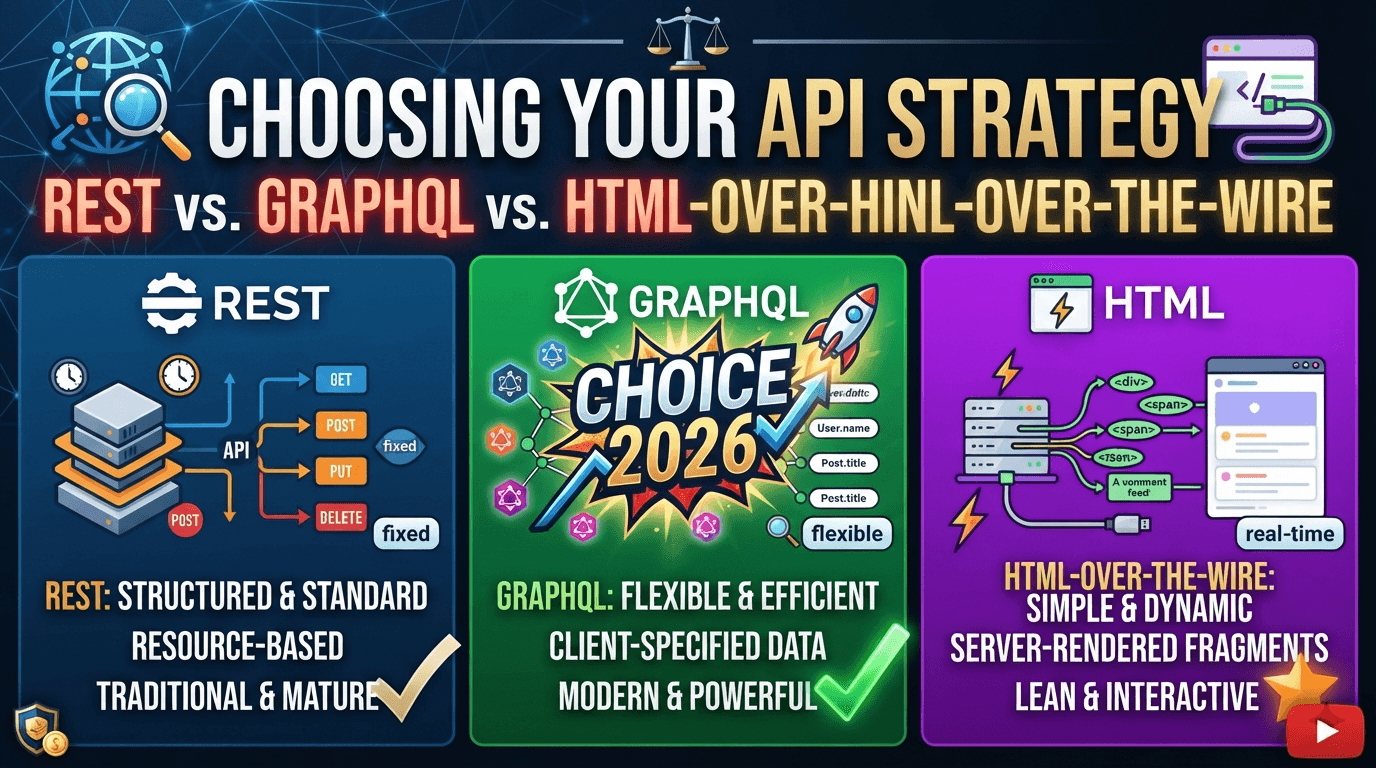
REST vs. GraphQL vs. HTML-Over-the-Wire: Choosing Your API Strategy in 2026
In the rapidly evolving world of web development, choosing the right API strategy is paramount to the success, scalability, and maintainability of your application. What started largely with REST has diversified significantly, offering developers more specialized tools for different use cases. As we look to 2026, the landscape is dominated by three main contenders: traditional RESTful APIs, the powerful GraphQL, and the resurgent HTML-Over-the-Wire approach.
Each offers distinct advantages and trade-offs. Understanding these nuances is key to making an informed decision that aligns with your project's specific needs, team's expertise, and performance goals.
The Enduring Power of REST
Representational State Transfer (REST) has been the de-facto standard for building web APIs for well over a decade. Its principles — statelessness, client-server separation, cacheability, and a uniform interface — have proven incredibly robust for a wide array of applications.
Key Characteristics:
- Resource-Oriented: Data is exposed as resources (e.g.,
/users,/products). - Standard HTTP Methods: Uses GET, POST, PUT, DELETE for CRUD operations.
- Stateless: Each request from client to server must contain all the information needed to understand the request.
- Hypermedia: HATEOAS (Hypermedia as the Engine of Application State) is a core principle, though often overlooked in practice.
Pros:
- Simplicity and Familiarity: Widely understood and supported across languages and frameworks.
- Caching: Leverages standard HTTP caching mechanisms effectively.
- Scalability: Statelessness simplifies horizontal scaling.
- Tooling: Mature ecosystem of tools for testing, documentation (e.g., OpenAPI/Swagger), and client libraries.
Cons:
- Over-fetching/Under-fetching: Clients often receive more or less data than they need, leading to multiple requests or inefficient data transfer.
- Multiple Endpoints: Complex applications can end up with many endpoints, making client-side data orchestration challenging.
- Versioning: Managing API versions can be cumbersome.
The Flexibility of GraphQL
Developed by Facebook, GraphQL emerged as a powerful alternative to REST, specifically designed to address the challenges of data fetching in complex client applications. It allows clients to precisely define the data they need, reducing over-fetching and consolidating multiple requests into one.
Key Characteristics:
- Single Endpoint: All requests go to a single
/graphqlendpoint. - Declarative Data Fetching: Clients specify the exact data structure they require.
- Strongly Typed Schema: Defines the data types and relationships available in the API.
- Real-time Capabilities: Built-in support for subscriptions for real-time updates.
Pros:
- Efficient Data Fetching: Eliminates over-fetching and under-fetching; clients get exactly what they ask for.
- Reduced Round Trips: Consolidates multiple REST requests into a single GraphQL query.
- Improved Developer Experience: Strong typing, introspection, and excellent client-side tooling (e.g., Apollo Client).
- Schema Evolution: Easier to evolve the API without breaking existing clients.
Cons:
- Complexity: Steeper learning curve for both backend and frontend teams.
- Caching Challenges: Standard HTTP caching is less effective due to the single endpoint and dynamic queries.
- File Uploads: Can be more complex than with REST.
- N+1 Problem: Requires careful resolver implementation to avoid performance pitfalls.
The Resurgence of HTML-Over-the-Wire
HTML-Over-the-Wire (HOTH) is a paradigm that prioritizes server-rendered HTML and minimizes client-side JavaScript. Frameworks like HTMX and Turbo (from the Ruby on Rails ecosystem) are leading this charge, offering a compelling alternative for many web applications, especially those seeking simplicity and performance.
Key Characteristics:
- Server-Side Rendering (SSR): The server renders HTML, which is sent directly to the client.
- Partial HTML Updates: Instead of JSON, the server sends small HTML fragments to update specific parts of the page.
- Minimal JavaScript: Interaction logic is often handled by server-side code or simple declarative attributes on HTML elements.
- Hypermedia-Driven: Emphasizes the use of standard HTML links and forms, enhanced with attributes for dynamic behavior.
Pros:
- Simplicity: Reduces the need for complex client-side state management and JavaScript frameworks.
- Faster Initial Load: Full HTML pages can be rendered quickly by the server.
- SEO Friendly: Content is readily available for search engine crawlers.
- Productivity: Allows full-stack developers to work primarily in one language/framework.
- Performance for Many Apps: Can offer a very snappy user experience by sending small HTML diffs.
Cons:
- Server Dependency: Heavily relies on server-side rendering, which might not be ideal for highly dynamic, client-heavy applications.
- Less Suited for SPAs: Not ideal for single-page applications with complex client-side logic and rich UIs.
- Network Latency: Every interaction requires a round trip to the server, though clever caching and prefetching can mitigate this.
- Tight Coupling: Strong coupling between frontend interaction and backend rendering logic.
Choosing Your API Strategy in 2026
The
Comments
Share your thoughts on this article.
Loading comments…