Unpack the economics of online marketplaces. Discover why platforms charge commission, what services these fees cover, and how to strategically navigate them for both freelancers and clients.
Explore how agentic AI is transforming web user experience, moving beyond reactive interfaces to proactive, goal-oriented interactions that anticipate user needs and streamline workflows.
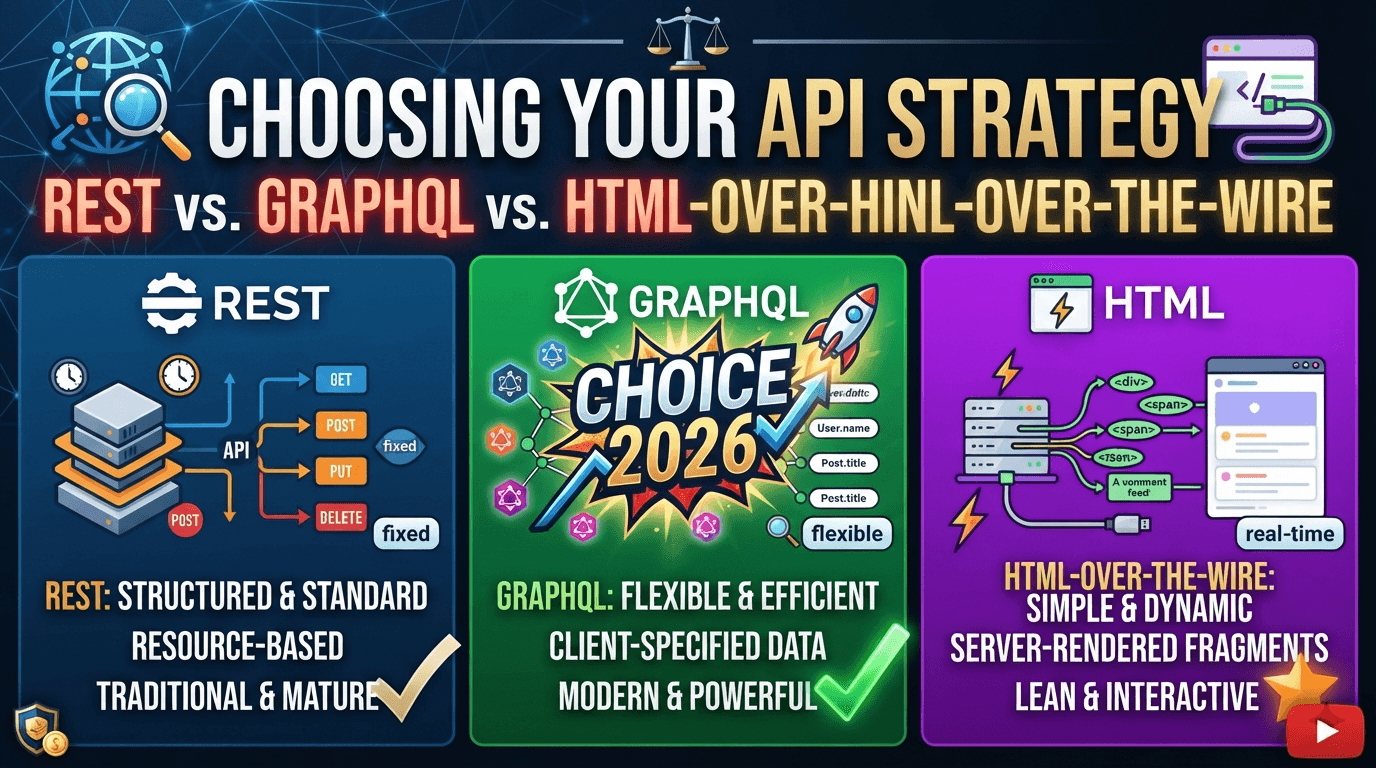
Explore the strengths and weaknesses of REST, GraphQL, and HTML-Over-the-Wire to select the optimal API strategy for your web application in today's evolving development landscape.
Explore the resurgence of native CSS and how its advanced features are challenging the dominance of utility-first frameworks like Tailwind CSS in modern web development.
Explore the best strategies for developing internal tools in 2026, comparing no-code platforms, custom development, and hybrid approaches to help businesses make informed decisions.
Navigate the evolving landscape of freelance scams in 2026. Learn to identify sophisticated red flags and master proactive client vetting techniques to protect your freelance career.
The rise of AI is intensifying pressure on freelancers, making mental health support crucial. Discover why clients offering wellness resources are gaining a competitive edge in 2026's talent market.
Explore the latest freelance platform fees in 2026, comparing the commission structures of giants like Upwork and Fiverr with the 0% commission models of Braintrust and Contra to help you maximize your earnings.
Progressive Web Apps (PWAs) are no longer a niche technology; 2026 marks a turning point where their enhanced capabilities, widespread browser support, and clear business advantages make them a strategic imperative for modern web development.
In 2026, AI literacy is no longer a bonus but a core requirement for freelancers. This shift, coupled with rate bifurcation and a demand for measurable impact, redefines the freelance landscape, demanding new skills for sustained success.
Explore how the rise of AI impacts system resilience and the evolving role of chaos engineering. Discover whether AI integration strengthens or weakens complex digital infrastructures by 2026.
Discover how the rise of LLM-powered search engines requires a fundamental shift in content strategy and site structure. Learn to optimize your content for semantic understanding, comprehensive answers, and authoritative summarization, moving beyond traditional keyword-focused SEO.
Explore the evolving landscape of headless CMS in 2026, weighing its benefits against the inherent complexities to determine if it remains a viable solution for modern web development.
Stay ahead in the gig economy with our August 2026 roundup of the latest feature releases and updates from top freelance platforms like Upwork, Fiverr, and Toptal. Discover new tools designed to boost your efficiency and client acquisition.
Discover the anticipated freelance rates across various in-demand niches for 2026, helping you price your services competitively and strategically. This report provides insights into what professionals are truly earning.
Explore whether the freelancing world offers opportunities for newcomers in 2026 amidst AI advancements and market shifts. Discover actionable strategies to build a successful freelance career from scratch.
The freelance economy has shifted from high-volume entry-level gigs to specialized, high-value consulting. As generative AI automates routine tasks, successful freelancers are adapting by positioning themselves as AI workflow integrators, pivoting toward recurring retainer models, and building "micro-agencies." This article outlines the top trends driving independent work today and actionable strategies to stay competitive.
The web development landscape is undergoing a massive transformation in 2026. With AI coding assistants evolving from simple autocomplete tools to full-fledged architectural partners, the role of a developer is shifting from writing boilerplate to orchestrating complex systems. This article explores the biggest trends shaping the future of coding, including the mainstream rise of WebAssembly, the shift toward edge computing, and how modern developers can stay ahead of the curve.
The web development landscape moves fast, but 2026 is proving to be a true inflection point. We’re moving past incremental updates into an era defined by intelligent user experiences, extreme rendering speed, and hyper-personalized interaction.
Whether you’re building client projects, managing web apps, or keeping your own site ahead of the curve, here are the seven key trends redefining modern web development.
Discover how implementing structured data, crafting citable snippets, and ensuring source clarity can significantly improve your content's findability, trustworthiness, and user experience in today's information-rich landscape.
Interaction to Next Paint (INP) is replacing First Input Delay (FID) as a Core Web Vital. Learn what INP measures and the key strategies development teams are implementing to optimize user interaction responsiveness.
Explore the strengths and ideal use cases for Rust and Python in 2026. Discover which language is the best fit for your next learning endeavor based on performance, development speed, and career goals.
Explore the evolving landscape of AI-powered and human-centric products. Discover which approaches are dominating the market and why, with key insights for product development.
Explore the essential Python best practices for 2026, covering everything from modern dependency management and type hinting to asynchronous programming and robust testing, ensuring your code is efficient, maintainable, and future-proof.
The article outlines a major shift in software development: moving from AI Copilots to Multi-Agent Systems (MAS). While traditional copilots simply act as smart autocomplete assistants requiring line-by-line human prompts, Multi-Agent Systems deploy networks of specialized AI agents (e.g., product, coding, testing, and security agents) that work together autonomously to solve complex tasks. Instead of replacing developers, this shift elevates them from manual code-writers to high-level system architects and AI orchestrators.
This article highlights the latest platform upgrades tailored for creators, developers, and businesses, focusing on improving workflow efficiency and performance.
The primary trend in 2026 is the transition from manual coding to Agentic Orchestration. Developers are moving away from writing every line of logic and instead focusing on designing systems where "AI Agents" work in coordinated teams.
Building a home lab is one of the best ways for beginners to learn practical technology skills. A home lab allows users to practice servers, networking, virtualization, Linux systems, and cybersecurity in a safe environment at home. Using old computers and free software, beginners can gain hands-on experience without spending a lot of money. Home labs also help students prepare for careers in IT, cloud computing, and system administration by improving problem-solving and technical knowledge. Even though beginners may face errors and technical challenges, regular practice and patience help build confidence and real-world skills. Technology learning is mostly trial, error, and stubbornness anyway. The machines simply pretend otherwise.
Exploring the 2026 career landscape where "AI Fluency" is no longer optional, and the most successful professionals are those who blend technical mastery with soft-skill orchestration.
Clients are tired of generic, robotic content. Discover how the most successful freelancers are using AI as a "junior assistant" while keeping their human creativity at the center.
With Pakistani IT exports surging to record highs in early 2026, we analyze how local designers and developers are moving from low-cost gigs to high-value global partnerships.
A deep dive into how modern freelancers are moving away from "just design" to offering integrated frontend solutions, and the massive impact this has on project success.
Breaking the myth of "narrow specialization" and showing how having a diverse skill set (Writing + Coding + Designing) makes you indispensable to global clients.
Why 2026 is the Year of the "Human" Brand: Standing Out in an AI-Saturated Market?
As AI content floods freelance platforms, authenticity and personal storytelling have become the most valuable currencies for freelancers.